

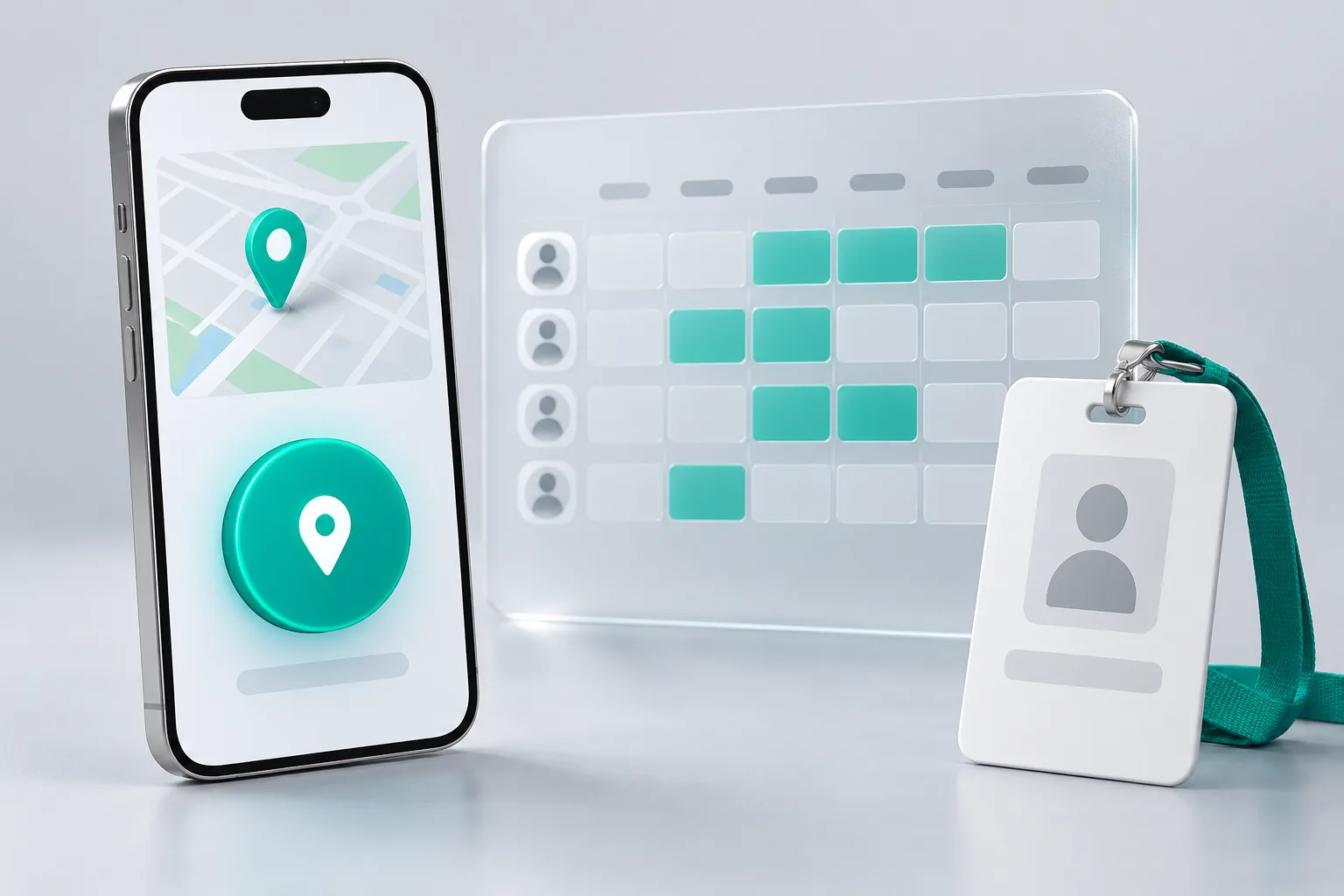
An attendance system records when each employee starts and finishes work, and where. Saree3 builds attendance and HR apps for companies in Jordan with staff in offices, factories, branches and in the field. We have built one already: Masar, an attendance and field tracking app for TechLine Factory, where staff clock in and out from company phones and each working day comes back to managers as a short written summary.
Phone check in or a fingerprint device
A fingerprint or face device on the wall works when everyone starts the day in the same building. It stops working when they do not:
- Sales reps, technicians and drivers start the day at a client site, not at the office.
- Staff move between several branches or project sites.
- The device report has to be exported, cleaned and typed into payroll every month.
With a phone app, the check in happens where the work starts, and the record reaches the system with the time and the phone's location. Many companies keep the wall device for the office and add the app for everyone else, and both feed one attendance record.
How GPS check in works
- The employee opens the app and taps check in. The app records the time and the phone's location.
- The location is compared with the places the company has set, such as the head office, a branch or a project site. A check in far from every allowed place can be blocked, or accepted and flagged for the manager.
- At the end of the shift the employee checks out. In Masar, location is recorded only between clocking in and clocking out, never outside working hours.
- Managers see who is in, who is late and who has not checked in yet, by branch or by team.
Phone locations can be faked with special apps, so the system should make that harder. It can save the accuracy of each reading, flag readings that jump between distant places, and tie each account to one registered phone. Masar alerts managers when something stops the tracking, such as a new phone or tracking switched off.
What the system can include
- Shifts and schedules. Fixed hours, rotating shifts, split shifts and a different weekend per branch.
- Lateness and overtime. Calculated from the shift, with the grace period you choose.
- Leave. Annual, sick and unpaid leave requested in the app and approved by the manager, with balances updated on approval.
- Field visits. Visits to client sites logged with time and place. Masar uses names the company sets, such as the factory, instead of street addresses.
- Employee records. Contracts, documents and reminders before a permit or licence expires.
- Payroll. A monthly sheet of days, hours, lateness and overtime for your accountant, or payroll calculated inside the system.
- Reports. Attendance by person, team and branch, absence patterns and a monthly summary.
Jordan rules to build around
Jordan's Labour Law sets normal working hours at 8 a day and 48 a week. Overtime is paid at 125% of the normal wage, and at 150% on the weekly rest day and public holidays. The system calculates with the rules your payroll already uses, and your accountant confirms them before launch. If your company has its own policy, such as a longer grace period or a Saturday shift, the system follows the policy.
Location is personal data. Tell staff in writing what the app records and when, record location only during working hours, and use company phones where you can. Jordan issued a Personal Data Protection Law in 2023, so ask your lawyer to review the staff notice before launch.
What we learned building Masar
TechLine Factory has staff who spend much of the day at client sites and on the road. Masar runs on the Android phones the company issues. The app keeps working in the background during the shift, even when the screen is off. When there is no signal, points are saved on the phone and sent when the connection returns. Instead of a table of coordinates, each day reads as a few lines, for example moved from Sweifieh to Wadi Saqra at 10:35. Accounts are created only by the company's admin, and a written setup guide lets the company prepare new phones without waiting for us.
The lesson we bring to every attendance project: managers read sentences, not maps. Who was where, and when, should fit on one screen.
Phone app, web dashboard or both
Staff use the phone app to check in, request leave and log visits. Managers and HR use a web dashboard on a computer for schedules, approvals and reports. The app can be Android only, as Masar is, or Android and iPhone from one codebase.
Price and timeline
A first version of an attendance or tracking app starts at 2,500 JOD. Apps with several roles, such as staff, supervisors and HR, start at 6,000 JOD. Most apps take 6 to 14 weeks. The final price is fixed in writing after a short discovery call. After the final payment you own the code, the design files and the cloud accounts, and care plans start at 80 JOD a month. See pricing.